
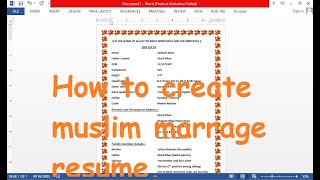
A marriage biodata is a comprehensive document that encompasses essential information about an individual looking to get married. This data covers personal information, hobbies, educational background, work and employment history, as well as details about family and relatives.
Muslim Marriage Biodata provides a platform to create beautiful Islamic Wedding Biodata to help people find their life partner. It comes with 100+ templates and awesome biodata Word files for free download.
Personal Details
Traditionally, Muslim couples celebrate their wedding with a traditional feast known as Valima. This ceremony combines family and friends into one large group and is held to wish the couple good luck in their future adventures together. A traditional valima banquet may include food such as dried dates, almonds, and delicious sweets.
While choosing a marriage biodata format, you must remember to select a design that is not only stylish and attractive but also fits your budget and lifestyle. A well-designed biodata will not only make a good first impression but it will also help you stand out among your prospective grooms and hens. We have created a couple of sample biodata formats, each with a little extra something that is sure to impress your prospective grooms. You can print them off for a nice keepsake or share them via email or WhatsApp. The best part is, all you need to do is fill in the details and affix your picture. It’s the smartest way to make a great impression on your future husband!
Hobbies & Interests
Muslim couples spend a lot of time getting to know each other. This can be through work, school, mosque, a hobby or interest group, etc. Once they find that they are compatible with one another, it is time to begin thinking about the wedding.
Traditionally, marriages are arranged between two individuals who have been introduced through their family or friends. This can be as formal as a matchmaker sending the bride and groom marriage resumes or as informal as friends introducing them to one another.
Islamic couples look for two things in a potential spouse-religion and character. While many factors play into this decision, these two things are often the most important for Muslims.
In addition to their religion, Islamic couples also want someone who has good moral values and who will support them in their religious practices. This can include things like sharing their religious beliefs with the other person, practicing good manners and respecting other people’s privacy.
The best way to determine these traits is to get to know a person through their hobbies and interests. This could include serving the needy, teaching the underprivileged, traveling to different countries, reading, or other activities.
Having hobbies and interests is an essential part of an islamic wedding biodata, as it helps to give the reader a glimpse into the couple’s personalities. It can also help to make the couple stand out from their peers and ensure that they are a good match. Adding these details to an islamic marriage biodata is simple, as long as the information is accurate and up-to-date.
Education & Training
Education and training are terms that describe the process of imparting knowledge to a person, which develops their sense of reasoning, understanding and judgement. This is often done to improve an individual’s skills in a particular area, such as a job or career.
Traditionally, the word ‘education’ referred to learning in school or college, but it also applies to learning outside of the classroom, through self-education, etc. It aims to deliver knowledge about facts, events, values, beliefs, general concepts, principles and other related topics that help an individual gain the required expertise to tackle different challenges.
The concept of ’akhlaq islamiyah’, or Islamic ethics, is a vital component of this approach. It focuses on the achieving of a noble Islamic personality, which is encouraged in the Qur’an and exemplified by Prophet Muhammad (p. 97).
Although many authors refer to the three spheres of ’akhlaq islamiyah’, it is important to remember that they are not mutually exclusive. The first sphere deals with acquiring knowledge about Islam and its practice. The second sphere is concerned with a Muslim’s moral and social behaviour, such as ta’deeb. The third sphere is based on the development of one’s own personal character, encompassing the rational, spiritual and moral dimensions.
As such, IRE courses can be seen as being a significant part of the education policy for Belgian Muslims. However, IRE has become the target of heated debates in the public, academic and political arenas. Its teachings are now being held accountable by the Belgian authorities, with the Executief van de Moslims van Belgie (EMB) and the Centrum voor Islamonderwijs (CIO) explicitly appointed as partners in the 'Action Plan Radicalisation' launched by the federal government and the Flemish government (2015b, 2016, 2017a, 2018). They are expected to act as an effective counterbalance against the radicalisation of young Muslims through IRE classes.
Work & Employment Details
Most Muslims are lucky enough to be able to pick and choose their employment options, so a well crafted work plan is a must for the happy couple. In the name of the gods and a healthy budget, a well planned out work schedule is the most productive way to spend one's days and nights. A reputable employer will also provide you with the best possible office space and a top of the line computer equipment.
Family & Relatives
When it comes to the wedding world, there are numerous nuances and traditions to consider. Muslim weddings are no different. Whether you're attending as a guest, working as a wedding vendor, or participating as a family member, it's important to know the details of what happens at a Muslim wedding.
The first step to planning an Islamic wedding is deciding on a date. Couples should get in touch with their local mosque to find out when a date is available. Then, they should pick a time and venue and invite their friends and family.
It's also a good idea to get a time and date in place with the Imam for your Nikah, which is the official Islamic marriage ceremony. In most cases, this will be at a mosque but some couples may choose to have the ceremony at a different location.
Once the date and time are set, it's important to ensure that all the necessary paperwork is complete. The paperwork includes a mahr (Marriage Contract), which must be signed by both the bride and groom.
A Maulvi will then perform the primary Muslim wedding ritual called Ijab-e-Qubool, which is similar to saying "I do" in Christianity. Both the bride and groom must say “Qubool hai” thrice, behind a hijab, to give their consent to be married.
Traditionally, Nikahs are held in mosques but many Muslims are now opting to have them at their own homes or other venues as well. It's a great way for families to gather together, celebrate, and share in the excitement of their daughter or son's big day!
Another Muslim wedding tradition is a baraat. This is where the groom and his male family and friends are escorted to the wedding venue by the bride's family. It's a spectacular, loud procession that often involves musicians and a white horse.